Motorcycle premieres
Presentations of noteworthy restored or originally preserved NSU motorcycles.
- Details
- Category: Motorcycle premieres
-
 By Radek
 - Parent Category: Workshop
- Hits: 112
 It so happened that at the beginning of the 21st century, I was ripe for owning a pre-war motorcycle. I stumbled upon a 1939 NSU 251 OSL, which I purchased in parts after selling a Junak M10 with a W03A sidecar and a full trailer of spare parts. A few years of restoration and I could enjoy a running quarter-liter-size motorcycle, which made me realize how interesting NSU motorcycles are in terms of design. The combination of "English character" and German craftsmanship resulted in a very capable vehicle (for less than 250cc). Of course, while assembling, restoring, and operating the 250, I deepened my knowledge of the brand's history and the models produced at the factory in Neckarsulm. Larger models increasingly fired my imagination. What if I tried to tackle the "big OSL"? And so it happened. In December 2019, I acquired the remains – an NSU 351 OSL from 1936. Remains, because what I brought home couldn't really be called a motorcycle in need of restoration. But there were plenty of parts. It was just a "mixed mess" - parts from various years, gathered into a pile of junk from which someone wanted to build a motorcycle. The kit also included documents matching the frame and engine numerically.
- Details
- Category: Motorcycle premieres
-
By Radek
- Parent Category: Workshop
- Hits: 476
Some time ago, I received an NSU 351 motorcycle purchased in Lithuania by my friend Krzysztof. He brought it to me straight from abroad with the order to bring this "safety pin" back to life. From the description over the phone, it was supposed to be a 1937 motorcycle, somewhat incomplete. OK, it arrived, so I'll have to take care of it.
 As usual, I started my inspection and determining what was missing and what wasn't from the given year. On the surface, it was quite complete (fenders, tanks, suspension, wheels, and even the headlight were all original). The mechanics, as the seller put it, were "as seen," but apparently the clutch cover couldn't be removed, so no one had looked inside, let alone dug into it, because the starter was missing and the gearbox was "locked." I was a bit surprised to find that the bolts (only three) had come loose on their own, but after opening it up, it became clear why it "couldn't" be removed. The engine block was missing a shaft, the valves were fake stems, and the gearbox was missing some gears and one shaft. Well, the fraud was exposed, but it didn't change the owner's decision to rebuild the machine.
- Details
- Category: Motorcycle premieres
-
 By Spiker
 - Parent Category: Workshop
- Hits: 1188
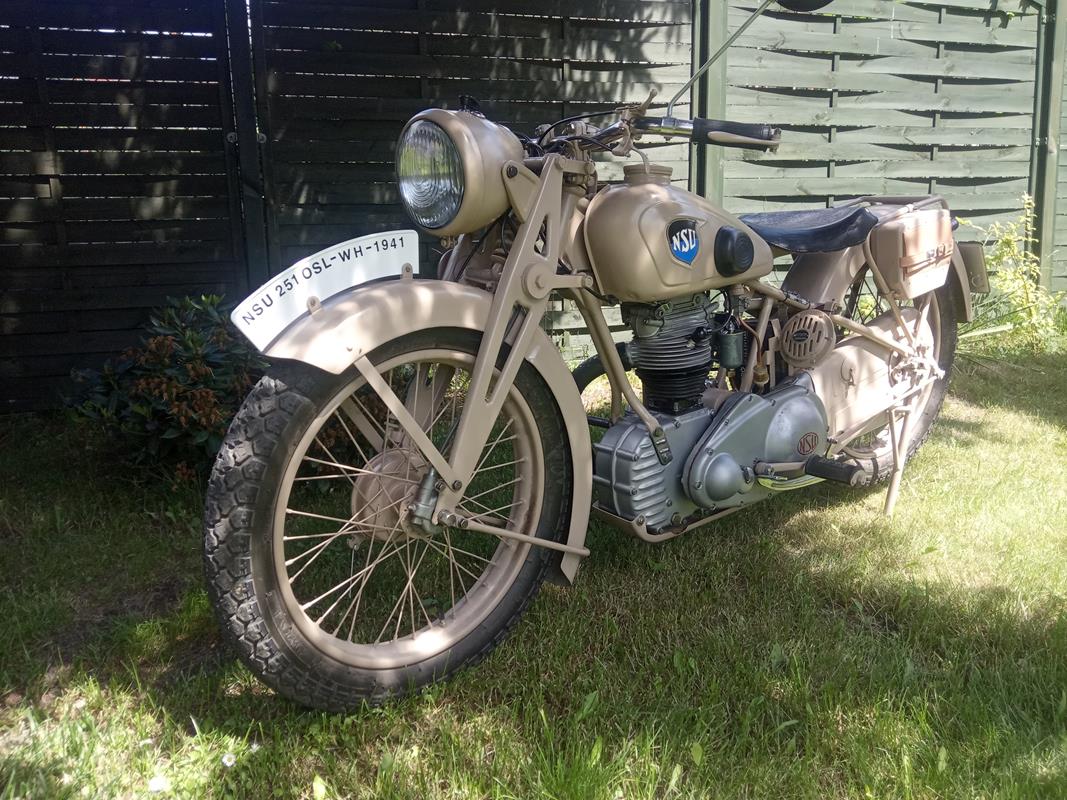 Jacek from Minsk's "Magnet" has been collecting NSU motorcycles for a long time, which are a springboard for him from faster riding on slightly younger motorcycles. This time he presented the newly completed 251 OS WH project. Previously, he had already restored another copy of the same model, but it was "from one piece", which was a great help. This time he undertook a more demanding reconstruction of a less complete copy of the "military quarter" (0.25l) from 1941. He did not avoid buying replicas of some parts, e.g. fenders. As it happens with replicas, it took a lot of time to fit them with the rest of the motorcycle. The carburetor was regenerated in a well-known NSU workshop in Lublin, so there is no problem with idle speed or regulation (to quote Jacek: "it runs like gold"). The motorcycle represents the war series, but still with aluminum casings of the drive unit and a typical Bosch lamp with an integrated ignition switch, but with a rocking seat (the popular "catapult"). However, the painting reflects a slightly later standard, i.e. a sandy color known as Dunkelgelb (in force since 1943 and according to some sources even since 1942). There is no mistake here, because vehicles from earlier years were successively repainted into new colors during the war, provided they survived the front conditions of course.
Login
Search
Who's online
We have 319 guests and no members online
Language switcher
Select your language
The site's multilingualism is under development and testing. Complete version for now only for PL language.


Recommended events